
Have you ever found yourself staring at a blank screen, desperately hoping for fate to produce the perfect blog post idea?
I can guarantee you’re not alone!
Creating consistent, engaging blog content is bloody hard work and can really make your brain feel like it’s going around in circles.
How good would it feel if you could take this frustration away in your business?
Good news! I’ll be sharing with you how to create a content calendar and some brainstorming tips so you can grow your business blog consistently and efficiently.
Are you ready?
As always, grab a cuppa, get comfy and we’ll get right to it!
Why You Need A Content Calendar
The short answer is that your sanity depends on it!
As a small business owner, I know it drives you mad to remember to update your blog regularly with amazing posts and to come up with ideas for the posts in the first place.
It’s like this: Imagine trying to drive from London to Edinburgh without a map. You might get there eventually, but you’ll probably take a few wrong turns and end up yelling at inanimate objects.
A content calendar is your roadmap to blogging success. It helps you plan, organise and execute your content strategy with military precision – minus the camouflage and boot camp drills.
A good content calendar will:
- Keep you organised – No more last-minute scrambles to publish a post. You’ll always know what’s coming up.
- Ensure consistency – Regular posting keeps your audience engaged and coming back for more.
- Help with idea generation – By planning ahead, you can ensure a steady stream of fresh, exciting topics.
- Boost SEO – A well-planned calendar allows you to strategically include keywords and trending topics.
Building Your Content Calendar

Step 1: Choose your tools
First things first, you need a handy tool that works for you. Whether it’s a fancy app or a good old Excel spreadsheet, pick something you’ll actually use.
Here are some popular options:
- Google Sheets: Simple, free, and shareable. Perfect for someone who loves a spreadsheet format.
- Trello: Great for visual planners who love a good drag-and-drop interface.
- Asana: Perfect for those who like to track tasks and deadlines.
- Notion: A versatile tool for more detailed planning and note-taking.
I personally use Trello. I love the layout and the fact I can drag and drop the cards if I feel I want to swap content and days around.
Step 2: Define your goals
Before you start using your chosen tool and filling in dates, you need to know what you’re aiming for.
Are you trying to drive traffic to your site, boost engagement or establish yourself as an industry thought leader?
Your goals will shape your content.
Step 3: Set your posting frequency
Consistency is key!
Decide how often you can realistically publish without burning out. Whether it’s once a week, twice a month or daily (if you’re a superhuman), set a schedule you can stick to.
If you can, I’d recommend once a week. Google will love you for it!
Step 4: Brainstorm content themes
Now comes the fun part – brainstorming!
Start with broad themes that align with your business and audience interests.
For example, if you’re a web designer, consider topics like “web design trends,” “SEO tips,” and “case studies.”
Step 5: Fill in the blanks
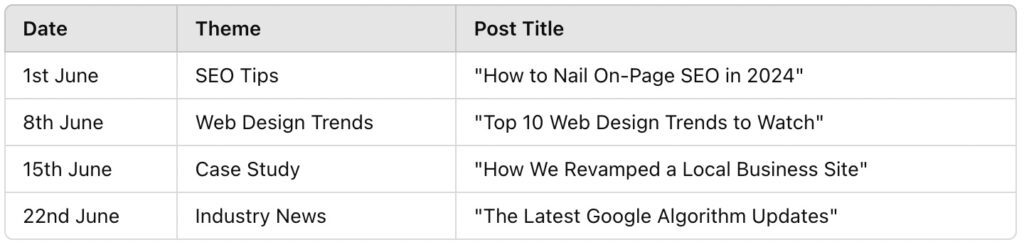
With your themes in mind, start plotting out specific post ideas. Use a mix of evergreen content (posts that stay relevant) and timely pieces (posts tied to current events or trends).
Here’s a quick example of what that might look like:
Brainstorming Engaging Blog Topics

Finding the right topics can be like searching for a needle in a haystack. But with a few tricks up your sleeve, you’ll be churning out winning ideas in no time.
- Know your audience – Understand what makes your readers tick. What are their pain points, interests and questions? Tools like Google Analytics and social media insights can provide valuable data.
- Keyword research – SEO is your best friend! Tools like Ahrefs, SEMrush and even Google’s own Keyword Planner can help you discover what people are searching for. Answer The Public is also a fantastic place to find great ideas.
- Keep yourself updated – Follow industry news, trends and influencers. This keeps your content relevant and timely.
- Repurpose old content – Got an old blog post that’s still getting views? Give it a fresh twist. Update the content, add new information or turn it into a different format like a video or infographic.
- Ask your audience – Sometimes the best way to know what your audience wants is to ask them. Use polls, surveys or even direct messages to gather ideas.
Scheduling Content To Be Consistent

You must be sick of me repeating myself by now, but consistency really is the key to a successful blog. Here are some things you can do to help make it easier to keep your content consistent:
Batch your content creation
I know it sounds slightly worse, but writing multiple posts in one go can actually be more efficient than switching between tasks.
I always dedicate a specific day each month to writing, editing and scheduling content. It makes life so much easier in the long run.
Don’t forget to refer to your content calendar!
Use automation tools
Tools like Buffer, Hootsuite and CoSchedule can help you schedule posts across various platforms, ensuring your content goes live exactly when you want it to.
I personally use Metricool because it gives me analytics for my blog posts, and then I can use the planner section to repurpose that content into social media posts.
Plan for flexibility
As much as we’d love everything to run smoothly, shit happens.
Build a buffer in your schedule for unexpected delays or last-minute changes. Having a few evergreen posts on standby can save your ass in these moments.
Track & adjust
You should monitor your blog’s performance regularly to see what works and what doesn’t.
Use this data to tweak your content calendar and improve your strategy.
Embrace The Journey

Creating a content calendar might feel daunting at first, but once you get into the groove, it can be a game-changer for your blog. It’s like having a GPS for your content strategy – guiding you, keeping you on track and helping you avoid those dreaded creative ruts.
Remember, consistency, creativity and a dash of fun are key to having a great blog. So grab your favourite planning tool, start brainstorming and watch your blog blossom into the engaging, SEO-optimised masterpiece it was always meant to be.
Want expert help for your blog?
If you’ve read this and are still feeling a bit confused, unmotivated or unsure, I’d be happy to help you.
Book a free call today and we can chat about your blog struggles.


